

 Evidence-Based Nutrition
Most magnesium supplements give you one form at a low dose and call it a sleep aid. Here's the science on why the type of magnesium - and the amount you actually absorb - changes everything.
The Short Answer
- Roughly half of U.S. adults don't get enough magnesium from diet alone.1
- Magnesium helps regulate sleep and muscle relaxation through the nervous system - it acts on GABA and calms nerve-muscle signaling.4
- Not all magnesium absorbs equally. Magnesium oxide is poorly absorbed; organic, chelated forms like glycinate and citrate are absorbed far better.7
- "Elemental magnesium" is the number that matters - it's the usable magnesium your body actually receives, and many products quietly underdose it.
- A well-formulated multi-form complex is designed to combine the strengths of several forms while delivering a full elemental dose - which is exactly how Schiffer's 8-form, 500 mg complex is built.
If you've ever stood in the supplement aisle staring at a wall of magnesium bottles - glycinate, citrate, oxide, "triple complex," 250 mg, 500 mg - you've run into a real problem: the labels look similar, but what's inside behaves very differently once it's in your body.
This guide breaks down two things that quietly decide whether a magnesium supplement helps you sleep and unwind, or just passes through: how many forms of magnesium it uses, and how much elemental magnesium you actually absorb.
First, the problem: most of us are running low
Magnesium is the fourth most abundant mineral in the body, and it's a workhorse - it's required for more than 300 enzymatic reactions, from energy production and protein synthesis to blood-sugar regulation, nerve transmission, and muscle function.2 Yet it's one of the most common nutrient gaps in the developed world.
Analysis of national nutrition survey (NHANES) data indicates that close to half of Americans fall short of the estimated average requirement for magnesium from food.1 One widely cited 2018 review went further, calling subclinical magnesium deficiency one of the most common - and most overlooked - nutrient shortfalls in developed countries.10 Depleted soils, processed diets, stress, and certain medications all chip away at our stores.
When magnesium runs low, two of the first places people notice it are the two this article focuses on: sleep and muscle tension.
How magnesium actually helps you sleep and relax
Magnesium isn't a sedative. It works upstream, by helping the nervous system shift out of "go" mode. It behaves as a natural NMDA antagonist and GABA agonist - in plain terms, it supports the calming, "wind-down" signaling that helps the brain and body settle before sleep.4
On the muscle side, magnesium and calcium work as a pair: calcium drives contraction, magnesium supports relaxation. Magnesium helps gate the calcium channels that tell a muscle to fire, which is why adequate magnesium is tied to normal muscle and nerve function - and why low levels are associated with cramping and tension.3
The clinical picture is encouraging, if still developing. In a small randomized, double-blind, placebo-controlled trial, older adults with insomnia who took 500 mg of magnesium daily for 8 weeks saw improvements in sleep measures and changes in melatonin and cortisol versus placebo.5 A 2023 systematic review of the literature concluded that magnesium status is meaningfully linked to sleep quality, while noting that larger trials are still needed.6 And a more recent randomized trial specifically tested magnesium bisglycinate in adults with poor sleep - one of the exact forms used in a complete complex.9
Why one form of magnesium usually isn't enough
Here's the part most labels gloss over. "Magnesium" on a bottle is never pure magnesium metal - it's magnesium bound to something else (an acid or amino acid) to make a stable, absorbable compound. That partner molecule changes three things that matter:
- How well it absorbs. Solubility and absorption vary widely by form. The body can only take up so much of any single form in one sitting.
- How gentle it is. Some forms (like citrate and oxide) pull water into the gut and can loosen stools at higher doses; others (like glycinate) tend to be gentler.
- Where it tends to go. Different forms are favored for different uses - calming and sleep, muscle and energy, or everyday repletion.
Lean on a single form and you're betting everything on one absorption pathway and one tolerance ceiling. The logic behind a multi-form complex is straightforward: spread the elemental magnesium across several well-absorbed forms so you're not maxing out any one pathway, you stay gentler on the stomach, and you cover more of the ways your body puts magnesium to work.
To be clear about the evidence: the strongest trials show benefits for magnesium itself at an adequate dose, rather than proving a head-to-head winner between "8 forms" and "1 form." The multi-form approach is a smart formulation strategy - combining the calming reputation of glycinate, the recovery profile of malate, and the proven absorption of citrate - not a magic number. What you should be skeptical of is the opposite: a single, cheap, poorly absorbed form sold at a dose that looks impressive on the front of the label but never reaches your bloodstream.
The 8 forms in Schiffer's complex - and what each brings
Schiffer's Natural Sleep Formula is built around eight complementary forms of magnesium, chosen so the calming forms and the recovery forms work alongside each other rather than competing:
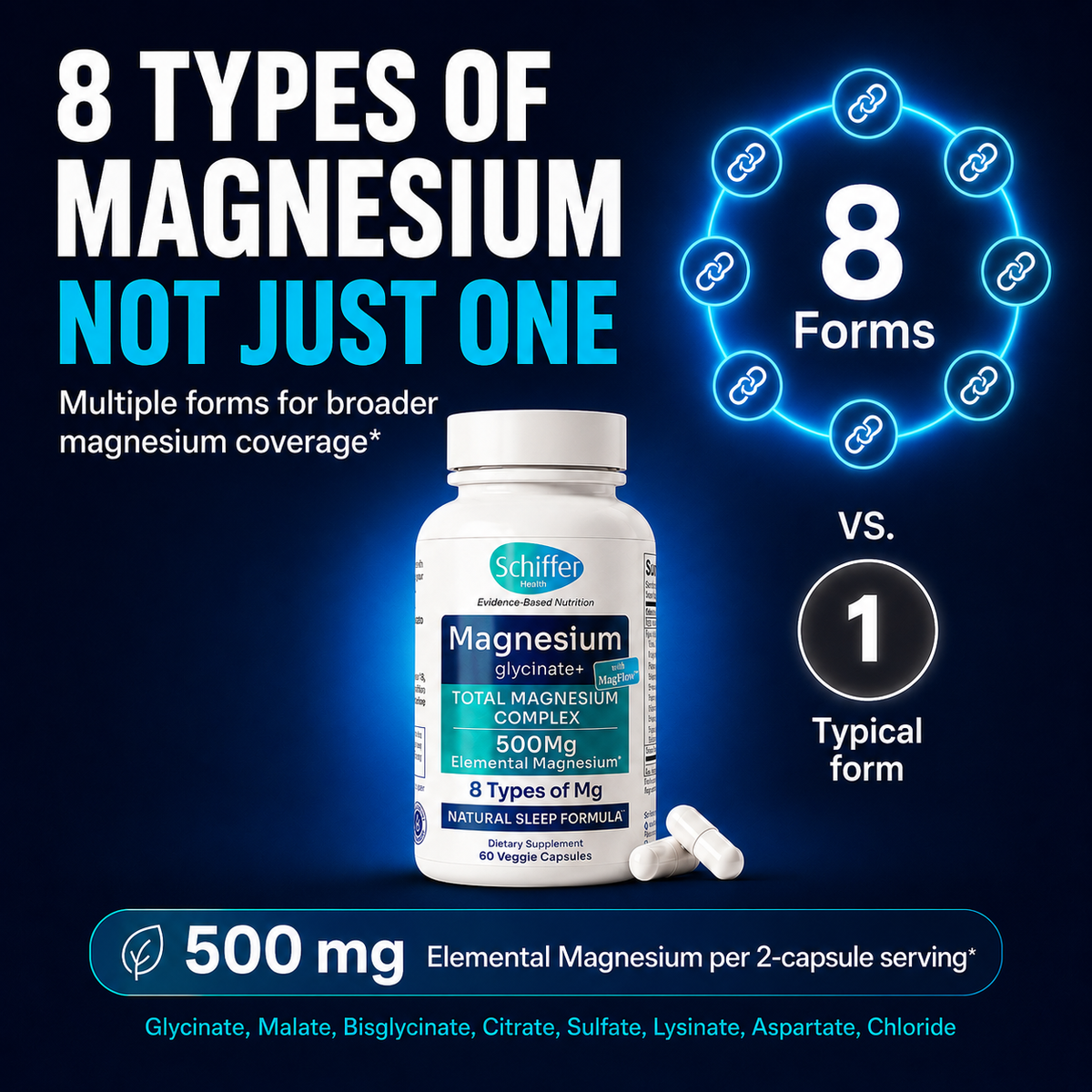
The blend is paired with Vitamin B6, which supports the way your cells take up and use magnesium, plus the proprietary MagFlow™ blend featuring bisglycinate - a form shown to absorb far better than cheap magnesium oxide.8 Notably, the formula contains no magnesium oxide filler, the poorly absorbed form many "high-count" complexes lean on to pad their numbers.
Built the way your body actually uses magnesium
8 complementary forms · a full 500 mg of elemental magnesium · MagFlow™ + B6 for absorption · third-party tested, vegan, non-GMO, made in the USA.
Why "elemental magnesium" is the number that matters most
This is the single most useful concept on this page. Because magnesium is always bound to another molecule, only a fraction of any compound's weight is actual magnesium. That fraction is the elemental magnesium - the usable amount your body receives.
It creates a trap. Magnesium oxide has the highest percentage of elemental magnesium of any common form, which is why budget brands love it - big number, low cost. The problem: oxide is poorly absorbed, with bioavailability estimates as low as a few percent.7 So a label can advertise a high milligram count while delivering very little usable magnesium. Meanwhile, gentler chelated forms like glycinate have a lower elemental percentage but are absorbed efficiently.
| Form | Elemental magnesium | Absorption |
|---|---|---|
| Oxide | High (~60%) | Poor |
| Citrate | Moderate (~16%) | Good |
| Glycinate / Bisglycinate | Lower (~14%) | Good & gentle |
| Chloride | Lower (~12%) | Good |
Values are approximate and vary by hydration and source.7
The takeaway: you need to look at both numbers together - the elemental magnesium amount and whether it comes from forms your body can actually absorb. A supplement that delivers a full 500 mg of elemental magnesium from well-absorbed forms is doing something a "500 mg of magnesium oxide" label only pretends to.
How to choose a magnesium for sleep (a quick checklist)
If you're comparing bottles, run them through this:
It's not a coincidence that this checklist describes how the Schiffer complex is built - that's the formula we set out to make after seeing how many "sleep" magnesiums were single-form and underdosed.
Frequently asked questions
Is a magnesium complex with multiple forms better than a single form?
For many people, yes - as a formulation strategy. Different forms absorb through different pathways and have different tolerances, so a multi-form complex can deliver a fuller elemental dose, stay gentler on the stomach, and cover more of the ways the body uses magnesium than a single form alone. The most important factors, though, remain the total elemental magnesium and whether the forms are well absorbed.
What is the best form of magnesium for sleep?
Magnesium glycinate and bisglycinate are the forms most associated with relaxation and restful sleep, because glycine itself has calming properties and these forms are gentle and well absorbed. A complex that pairs them with other absorbable forms - plus Vitamin B6 - gives you their calming profile alongside a complete dose.
What does "elemental magnesium" mean?
It's the amount of actual, usable magnesium in a supplement, as opposed to the total weight of the magnesium compound. Because magnesium is always bound to another molecule, only part of the compound's weight is magnesium itself. Elemental magnesium is the number that tells you how much your body actually receives.
Is magnesium glycinate the same as bisglycinate?
They're closely related - both are magnesium bound to the amino acid glycine, and both are valued for the same calming, sleep-supportive qualities and good absorption. "Bisglycinate" specifies the fully chelated structure (magnesium bonded to two glycine molecules).
How much magnesium should I take for sleep?
The recommended dietary allowance for adults is roughly 310–420 mg of elemental magnesium per day, depending on age and sex, and the clinical sleep trial referenced here used 500 mg daily. Schiffer's formula provides 500 mg of elemental magnesium in two capsules. If you have a medical condition, are pregnant or nursing, or take medications, check with your healthcare provider first.
When should I take magnesium for sleep?
Most people take it in the evening, with food, to support winding down before bed. Schiffer's directions are two capsules with your evening meal.
Is magnesium oxide bad?
It isn't harmful, but it's poorly absorbed compared with organic and chelated forms, so much of a high-milligram oxide dose may pass through unused. It's commonly used because it's cheap and high in elemental magnesium on paper. For absorption and gentleness, well-chelated forms are generally preferred.
The bottom line
Magnesium is one of the most evidence-supported nutrients for sleep and muscle relaxation - but only if your body can actually absorb a meaningful amount of it. That comes down to two things the front of the label rarely makes obvious: the forms of magnesium, and the elemental dose. Choose a supplement that uses several well-absorbed forms and delivers a full elemental amount, and you've solved for both.
Sleep deeper. Wake restored.
Schiffer Magnesium Natural Sleep Formula - 8 complementary forms, a full 500 mg of elemental magnesium, MagFlow™ + B6, with no oxide filler.
References
Disclaimer: These statements have not been evaluated by the Food and Drug Administration. This product is not intended to diagnose, treat, cure, or prevent any disease or health condition. This article is for general educational purposes and is not medical advice. Consult a qualified healthcare professional before starting any supplement, particularly if you are pregnant or nursing, under 18, have a medical condition, or take medication. Individual results vary.